Saturday, August 15, 2020

Winter around Ballina - part two

 So, on with the show, and the post to complete the winter trilogy 😕. Sometimes it is easy to forget (or take for  granted is probably a better description) the variety we have to enjoy. Colours, sounds, interactions, movements, environments ... even the same bird can look quite different in same setting - let alone a different setting, or changed light. Enjoy.

Ah yes, to begin this post, even the crow (more technically a torresian crow) can look magnificent! Curved beak, sleek shiny body and wings, bare black legs pierced by that all-seeing white eye. What a perch too!

Crow on the wall

This next sequence of four was taken in a bottle-brush on the lighthouse hill - a favourite spot to sit and enjoy the sight and sound of the Pacific Ocean, watch those denizens of the sea (the whales) migrate north to calve and south with their calves or just relax and read a book in the great outdoors. But this treat was about the birds ... the rainbow lorikeet (photo #2) is very common and very colourful and hard to miss even if you do not see them kamikaze past you their calls are very raucous and aggressive too! Not too far behind on ALL the characteristics is the scaly-breasted lorikeet, so you can imagine the racket when they decide to try to share the same nectar in the same tree 😅. I have a leaning towards the scaly-breasted lorikeet ... a little less exuberant and a little less gaudy but still striking and absolutely drop-dead gorgeous without being under or over stated ... of course, you be the judge and beauty is always in the eyes of the beholder!

Scaly-breasted lorikeet just checking

Rainbow lorikeet feasting

Scaly-breasted lorikeet on top of the world!

Scaly-breasted lorikeet on full alert

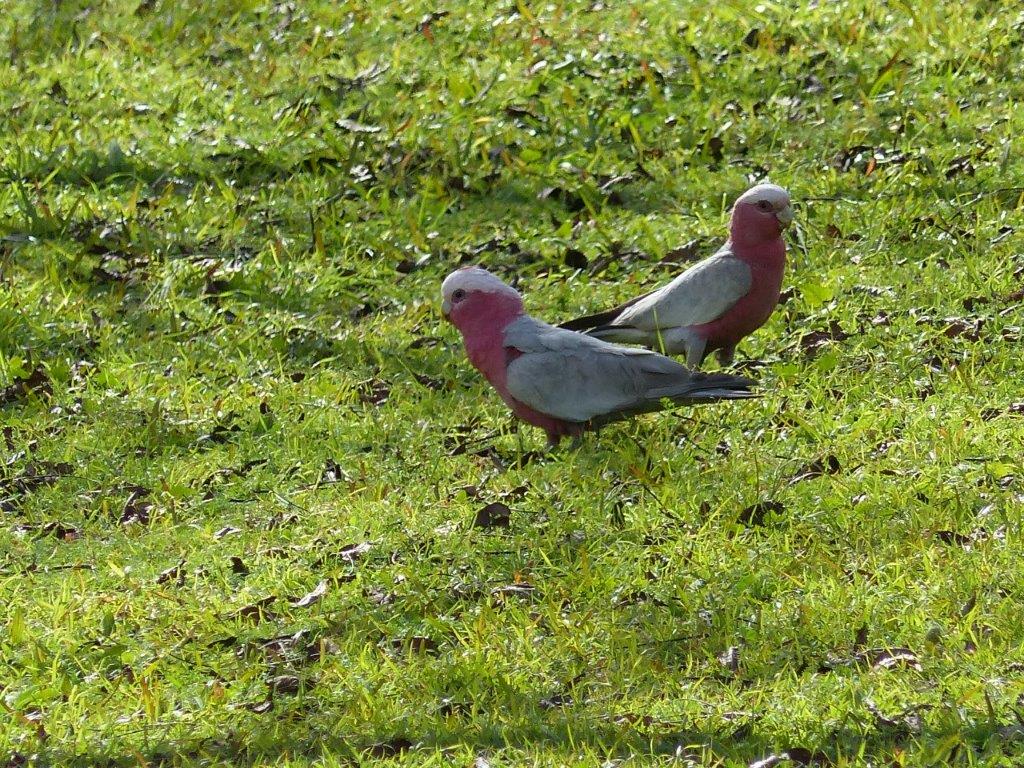
Next we have a couple of galahs grazing down on the earth rather than being silly and noisy on wires or tree branches. Foraging for seeds on the ground, enjoying a little winter shade.

Grazing galahs

Now babies, whatever kind are cute, right? Of course they are. This masked lapwing (plover) chick simply adds evidence to support the cute theory 👍. Who would imagine they grow to be such disagreeable (if quite stunning) adults!

Masked lapwing chick

Again, a treat from just being alert driving past the swampy lake beside the Bruxner Highway heading to Ballina from the west late one afternoon. First the black-necked stork having a bit to say in the setting haze of the afternoon sun providing a wonderfully soft landscape background (this one looks really good on canvas!). Very fortunate there is a lay-by you can turn into and that I had my camera with me. The third photo below was on another morning in the section of the same swamp further to the east along Teven road. Very still ... very calm ... very beautiful mirrored image of a black-winged stilt seeming to kiss itself very tenderly 😊 - or whatever you imagine it is doing!

Black-necked stork 

Not quite so raucous

Black-winged stilt


And to wind up this winter trilogy around Ballina, what is more iconic to that location than the pelican ... the big bird of the coast, the big glider and gulper that is both ponderous and graceful in flight and landing and paddling. A joy to behold in nearly any setting. We conclude with one setting atop the power poles near the sailing club, the other in full graceful flight heading along the river at the same site ... simply stunning.

Pelicans on a light (& pole)

In full glide mode


Winter around Ballina - part one

 One of the good things about writing, well blogging in this particular instance, is that it is fluid ... not pre-determined. It can lead where you are taken which does not always need to be where you intended ... rather like a good "trip" rather than a holiday (destination) ... if you need or want to stay or follow-up something more (or less) then having the flexibility to do so is a luxury 😀. So it is with this third post of my 2017 winter trilogy ...

I woke up this morning to a rainy wet day after some quite heavy and rain and wind strong winds overnight. Only showery now, but it always looks so fresh during and after the dampness of the rain. I thought of the last photo on the second post of this trilogy - a full Lismore Lake. This volume of rain, alas, will not have the same impact there. It did get me thinking about what I wrote above though as I gazed out across our wet backyard ... and this being the third post of the trilogy does not need to be. If it was, it would be a very long post (25 photos) and, well, I decided the final post of the trilogy can be delivered in two parts ... really just because it can. At this point you can tell I am well into my leave state of mind 👏!

So here we go: third post of the trilogy - part one (just because we can create our own reality some of the time!).

Despite my rambling above THIS is entirely serendipitous - the initial set of photos for this post happens to be a set of three! The third of the three you may recall as being the final one from my 2017 Exhibition way back near the beginning of this blog. What I decided to do here was attempt to convey a sense of how that photo evolved ... how I happened to be in the right place at the right time and was patient enough to wait and watch might happen ... something quite magical and a rare treat to find so many photogenic small birds still simultaneously 😊. What I call here a family of superb fair wrens.

First there were two ...

Then there were three ...

Then the family of four superb fairy wrens!


The next three (bird) photos offer some examples of birds enjoying basking in the sun ... to soak up the energy to replenish after hunting (the little pied cormorant by swimming and diving, the swallow by incredibly acrobatic flying chasing insects we cannot even see most of the time, and the royal spoonbills in treetops rather than wading & hoovering in the shallows). Who doesn't like to find a nice sunny spot out of the wind ... as I write this post, the sky is clearing and clouds clearing so my little nook has become my winter sun trap ... here is a photo to show you (ah, yes, more of that letting the writing take me where it does 😔).


Little pied cormorant

Welcome swallow


Royal spoonbills

And now to some of those stealthy wading hunters. The first one waiting patiently for its prey, the second two demonstrating the success of their prowess and patience! Whenever you see these wading, it is really worth taking the time to watch ... see them stand, stalk, poise, strike and then savour their catch! (The reality of the stalk is MUCH longer than the sequence of word just written can do justice 😉).

White-faced heron waiting and stalking


Egret savouring a successful hunt

And another success!


This brown honeyeater  is captured in an unusally clear photo for me - while they have the most beautiful singing voice among the mangroves, you can see they are much more easily heard than seen! Their camouflage is very effective.

Brown honeyeater

And what would a walk along the Ballina wall be (north or south wall) without finding a cold-blooded reptile basking on a warm rock enjoying the view. Very clear why they are called water dragons! Certainly no bird, but if you have seen them launch (from a branch, roof, rock, wall to name a few I have witnessed) they are not averse to flying through the air when they see a target or want to escape. This one did not launch!


And to finish part one of Winter around Ballina, what has become my "staple" expectation for a walk along Ballina wall - the sacred kingfisher. Just beautiful, if not possessing a palette quite as exuberant as the azure kingfisher, it is one that offers its own iridescence and variability depending on light perspective. Like all small birds, nervous but constantly on the lookout to launch across the water from it perch (winter sun-drenched rocks in these photos) when movement takes it eye. Like the suggestion for making time to watch the heron and egret hunt, so it holds for these ... seeing the speed and brilliant flash of aquamarines as they cleave the water is definately worth the wait.

Sacred kingfisher on the lookout

Sacred kingfisher looking out!


Friday, August 14, 2020

Winter at Lismore Lake

The second post of this trilogy presents photos from in and around Lismore Lake. Back in 2017 it had quite a deal of water in it ... at present it does not. An artificial lake that for many years was topped up with water from Wilsons River that runs parallel and as well as a wonderful public picnic space it was also a water reserve. When it was first created (I am really giving away my age here!) it was actually a water-ski lake. Unfortunately, and paradoxically, an environmental ruling meant that water from the river can no be used to keep it topped up and so during prolonged dryer spells, it dries up.

So here are some pictures for you to enjoy of the variety the full lake was attracting. You will see more in subsequent posts. One thing to keep an eye on, and that I have commented on in previous posts, is how different birds are quite comfortable sharing the same environment - of course, this is not always the case.

These three waders are both patient and efficient and have very similar strategies. The variety of plummage is a treat. 

Egrets & white necked heron


This little fella is both very pretty and colourful and fun to watch as they "duck-dive" and fly-off when their shyness alerts them to anyone close. The second one here is another perspective on the grebe with a Eurasian coot.

Australasian grebe
Australasian grebe & Eurasian coot

This next one is a lovely shot of a hardhead - the smooth mirrored surface only broken by it's wake. The striking yellow eye and white patch on the bill are key markers.

Hardhead

And here we have another pair sharing the bank as they forage for food.

Purple swamphen & magpie lark

This next sequence shows the magnificent azure kingfisher in full sunlight displaying it's dazzling colour pallette! The sequence also provides fantastic context and environment showing off just how small they are. I have my wife to thank for spotting this one as we were on the drive out. Thankfully it was not spooked when we pulled up 😀.


Azure kingfisher

Another wonderful reflection capturing the amazing variation in colour and the ease with which birds can navigate the muddiest of underfoot terrain and remain so clean!

Black-fronted dotterel

And the final two for this post offer a close-up of the distinctive plummage of the aptly named plumed whistling-duck followed by a wider angle of the flock on their island which shows what a wonderfully serene setting the lake is when full. 

Plumed whistling-duck

Plumed whistling-ducks on a full Lismore Lake


Winter close to home

 So, settled into my (2020) AL/LSL stint and have been focused on catching up on a lot of recreational reading. This is my usual way to ease into feeling like it is OK to take it easy and not be worried I "should be doing something" 😊. I have just started heading out again to take some photographs and that reminded to make sure I keep on top of catching this blog up ... so here I am ... back to the winter months of 2017.

Eclectic because the trips seem to be fewer in winter months (at least in 2017). Perhaps I was subconsciously yearning for a bit of a break given the intensity of my relatively recent conversion to birding? However such things are relative and while dedicated "days" may have been infrequent, the camera was mostly handy and so quite a range of birds and locations were covered. Turns out my search for winter photos to share fell into 3 broad geographical areas, so 

  • this post will cover sightings close to home (Victoria Park, Wollongbar and that "other" home Uni); 
  • the next post will cover a productive excursion to Lismore Lake; and 
  • the third post in the winter compilation will cover "around" Ballina.

Enjoy some new finds and more of some favourites ...

These first two were noticed during a walk around Victoria Park Nature Reserve. A real treat when you manage to do the whole (short) boardwalk loop without anyone else being on location. The silence and sounds are something to behold. These guys are way up in the treetops and identified by their frequent droppings while they are feeding. The second little fella, an eastern yellow robin was peeking out around a trunk showing off their agility.

Topknot pidgeon

Eastern yellow robin

Next two were treats on-campus out my window. Not everyday we get to be so up close and personal with a mum & joey and the treat was too good NOT to share because it is not a bird 😆. The second one is a bird ... a wonga pidgeon grazing on the hill side, also out my window. 

Swamp wallaby & joey

Wonga pidgeon


This handsome white-headed pidgeon is quite prolific and easy to see on powerlines after any shower of rain or even during the rain. This was out the front of our home. I love the proud chest , the crinkled feathers on the back of the neck and the red eyes. Quite something (and very different look) in the sunshine.

White-headed pidgeon

This is again stretching the idea of a "bird" ... but the sunflower in full bloom is always a sight to behold and the bees were loving it this day out at Eltham.

Sunflower(s) and bees

The remaining photos in this compilation were all taken at various points around Lismore campus. The black kites on two different days when they were scouring the football fields. I wanted to show off three quite different perspectives with these photos - as always with birds of prey it is a wonderful privilege to be able to share space and get so close to admire them. 

Black kite

Black kite on ground

Black kite about to launch


Once again, a rare treat that is NOT a bird, but it IS in a tree 😃 and like the wallaby with the joey, far too special not to share with you. Healthy and big!

Big healthy koala

Striated pardolote


Yellow-tailed black cockatoo

Black-shouldered kite


Magpie lark on mud nest

Richard's pipit


Rainbow lorikeet