Showing posts with label Pied cormorant. Show all posts

Monday, November 20, 2023

A quiet 3 months (Aug-Oct)

For a variety of reasons, mainly health related, this period was relatively quiet. Of course, preparations for our long-awaited driving trip to Tassie occupied much of our time too.

The selection below shows a variety of regular birds along several common areas we walk. "Regular" in terms of sightings they might be, but as usual, they also offer different appreciations of the capability and beauty of the birds.

First up I managed to frame this osprey alighting from the top of a riverside pine. More usually I photo these in static poses.


Next a youngish prancing plover (masked lapwing) just about to disappear into the shadow of a telegraph pole.


The next two photos show a rainbow lorikeet and a crested pigeon. The lorikeet is feasting on the nectar of the banksia flower while keeping a very keen eye on the photographer. The pigeon is in the same bush and roosting among the flowers to complement its wonderful plummage and also keeping an eye on the photographer.


Here is a pied cormorant basking on a boulder along the wall in the morning sun. The sheen on the wings and the black collar and head streak contrast strongly with the white neck and chest. The yellow beak is also a clear further contrast.
  

The same beauty of the soft pastel palette is perhaps even more apparent with this crested pigeon grazing on the grass among the clover, compared to the perch in the banksia shown above. Both have their own charm.


From pines, to banksia, to grass, to rocks, a plainer bare branch context against our wonderfully clear blue sky shows off the magnificent sounding (and looking) pied butcherbird. 
 

And a youngish magpie listening and feeling for any movement underground before it digs out the underground prey.


Showing off both the grass and rocky context is this white ibis preening its chest while balancing on a single leg ... such dexterity while ensuring they look their best 😁.


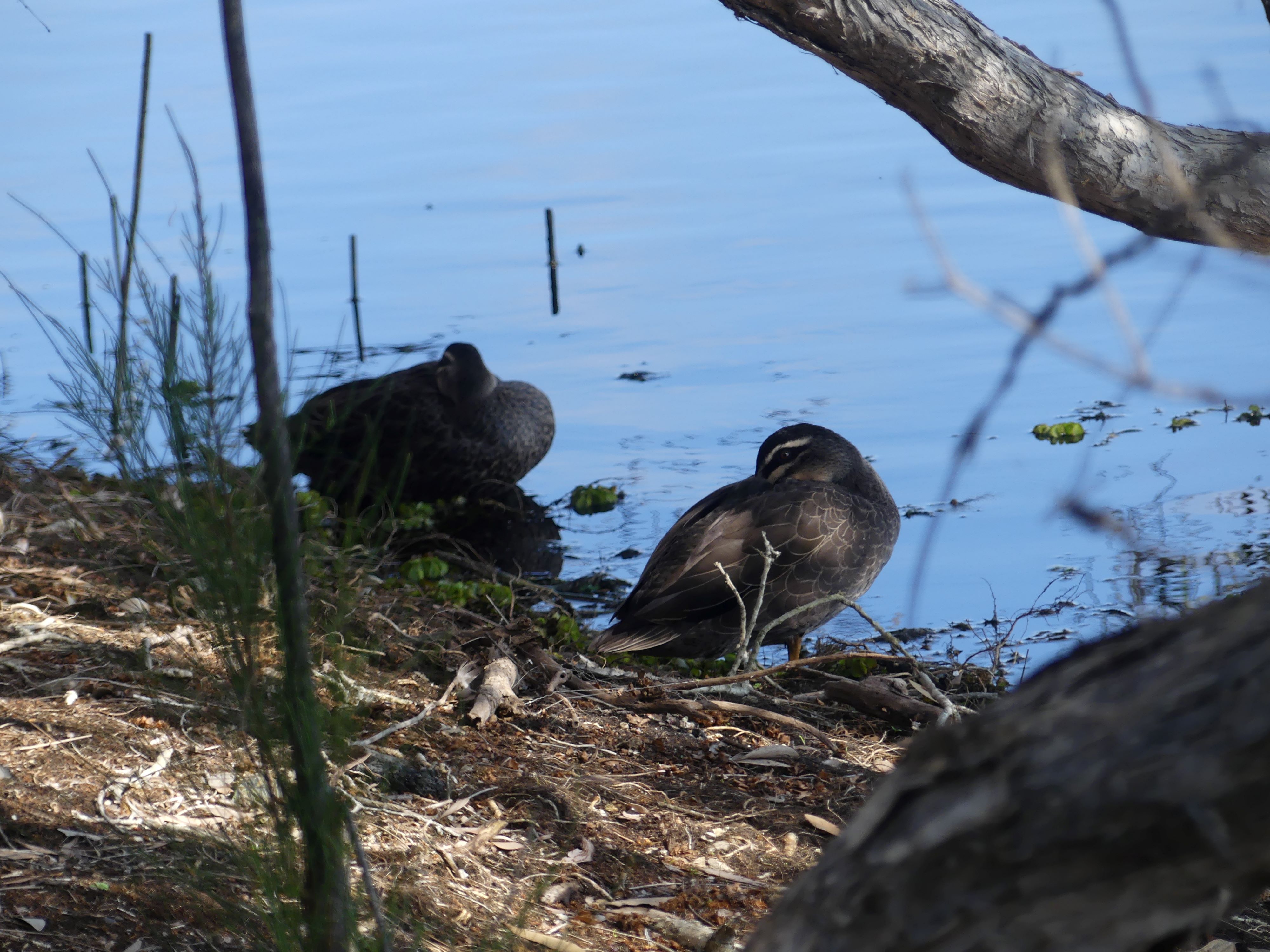
A pair of pacific black ducks by the edge of the lake enjoying some anonymity in the shadows.


The next two photos show a pair of welcome swallows enjoying the afternoon sun on their highwire perch. One caught at the beginning of a dive, and then in the second photo it has returned to the (deserved) admiration of its partner!


Another photo showing the acrobatic skills of the rainbow lorikeet.


Finally, just prior to our departure, a brush turkey decided he was going to build a nest in our front yard 😟. You can see in the first photo the spread of dirt behind the red flowers ... it had been moved there by the turkey from the nice clean path beside the birdbath. The next position was off to the left under a native magnolia tree ... the second photo shows to proud builder working the dirt & debris into position under the tree. On our return (mid-Nov) the nest is MUCH bigger and the yard much less tidy but boy, can these guys move a lot of material around in a short amount of time!


Monday, September 27, 2021

Two more days by the water (Feb 2021)

Yes, Ballina wall and surrounds is a favourite spot - also because it is a favoured walking route for my wife who is happy leaving me behind as I find things to photograph. On these couple of days I was fortunate to get up close and personal with some regulars, and others not featuring quite so often but all with their own special charms.

Such a location often provides non-bird special moments too. A couple are included below for your enjoyment. I have also taken the liberty of curating this post primarily by bird type, but ocassionally diverge to different themes ... just because it seemed to suit the chosen photos.

I begin with a brahminy kite in full flight. Speaks for itself 😁

Next is my first non-bird special sighting ... a peeking water dragon 😊. I love how the size of the boulder seems to add to the pre-historic grandeur and mystic of the "dragon" ... you never know what lies on the "other side".

Here is a young common tern honing its diving skills. The wings have just begun sweeping back into the full dive tucked position before heading more vertical ... a real sense of precisoin scouting is conveyed here.

Next I was greeted by a grunting (almost barking) darter who was just letting me know that I had been spotted and need not approach any closer 😖 ... I saw and heard the message! A little further along there was a young darter, much more polite, enjoying the warm sunshine - here you see perspectives looking into the sun and then with the sun more behind. The paler and softer down of the young feathers and the very pink webbed paddlers contrasts with the older bird in the first photo.


Next up is a pied cormorant which had just surfaced, replenishing the lungs following a dive expedition. I have more often seen the little pied cormorant so this one was a treat ... the bright yellow eyepatch is the distinguishing facial feature.


The next set is the welcome swallow. The second photo a closer zoom of the first one, and the third photo a treat to have captured one as it was about to alight on the perch. I am beginning to appreciate the better quality of my new camera model I think 😀.


While walking along watching the water, a shadow passed overhead. On turning, I managed to snap the first photo below of an osprey heading to a perch farther away to savour the taste of its successful hunt (more evidence of the better qualities of the new model) ... the second & third images of the set demonstrate just that satisfaction - the perch was on top of the Marine rescue radio mast.

The second non-bird special sighting is next. Watching the water often pays dividends and this time a turtle surfacing for some air, crustaecans and all! You can see what the pull back to the water is all about in this post 😋.


Next up is the ubiquitous silver gull. No more likely bird to be sighted near the sea and river than the seagull. Generally easy to photograph because they are NOT shy. They seem a totally different bird in a non-picnic and more natural environment (where they belong of course!) The second bird still looks composed despite the ruffled feathers 😉.

Now I share a set of pairs ... crested pigeons and galahs. The galahs especially have been captured in quiet unison grazing. The second set of galahs a younger pair evidenced by the less distinct pink feathers.


And while on galahs, this one may have been on lookout duty, but on review it looked so peaceful and contented in the casuarina I had to share the photo 😊.


Here a little wattlebird was heard and then sighted flitting among some dense branches. Again I note, the "drab" brown palette has its own charm among the foliage to enjoy, even without any blossoms in sight.


To conclude this post I offer a study of the pied butcherbird. On a lower branch of a Norfolk pine adjacent to where I parked the car, this fellow allowed me close-up privileges while I managed quite a few portrait photos. While generally inquisitive and tame, it is still a treat to be able to obtain co-operation so close in a natural setting rather than by feeding or a more obvious built environment. Always a treat when you capture eye contact. The butcher's hook is also very clear in several photos, as is the very fine (and soft) nature of the plummage.


I hope you enjoyed these walks by the water. I certainly enjoyed sharing them with you.


Wednesday, December 23, 2020

Wandering Brunswick Heads (March 2019)

The sun is out, the humidity is high, the cloudless sky invites a walk. I decide to drive to Brunswick Heads to explore a picnic area just on the north and coast side of the highway bridge. Like so many spots in our region, I was blessed with hardly anyone about ... just me, the water in the river, the trees and I hoped some birds!

I was greeted by the follwoing trio of clearly curious birds in the picnic area, very willing to share their space and not afraid to check me out. Welcome!

Willy wagtail perched on a branch


A brush turkey inviting me to sit at the table!

A tilt of the head by an eastern yellow robin.


Even allowed a close-up portrait - plumage so fine and delicate.


Not every day I get to contrast two types of cormorants in such close proximity.  Likely says more about my reluctance at this point to pursue and observe waterbirds too much. I will get there. Both basking in the sunshine between preens and perched on the oyster beds. I like the way the first one shows off the distinct thigh patch markings of the adult mating plumage. In addition, as with many "black" birds, the light here catches the variety of tones and shades and iridesence of the feathers, even against the busy background of the ruffled river surface. In contrast note the much clearer dominance of the white feathers on the Pied cormorant. The long pale bill and sharp blue eye distinguishes it from the smaller little pied cormorant (not shown here) which has a shorter yellow bill and dark eyes. If you click on the photo so it shows up as a larger image and look carefully you might also notice a small patch of pinkish red skin just under the eye - this indicates, as with the white thigh patch noted for the great cormorant, adult breeding plumage.Twas the time of the year!

Great cormorant

Pied cormorant


Then a fine feathered farewell on the picnic reserve sign by an eastern yellow robin.

Next I headed back over the bridge as I had noticed a flock of pelicans on the town side river bank adjacent to the boat ramp. What wander around a coastal estuary would be complete without some pelicans being sighted (especially near a boat ramp!). Selecting these few to share was quite the challenge ... when you have such willing muses, it is amazing how many photos you end up taking simply "because you can" - very easily! I will offer a brief thought to accompany each one for the delightfully ubiquitous pelican 😊

So this first one chosen encapsulated for me the "scene" ... the peaceful and tranquil preening on the rocks beside the southern shore framed by a couple of young casuarinas and even allowing uninhibited access to a silver gull! What's not to admire.

This next chosen trilogy is presented to offer a different perspective of peace and tranquility. This time their grace and synchronisity on the river; first a single bird on the lookout, then a pair. The symmetry of the first pair struck me as a neat contrast to the asymmetry of the same pair a few shots later where the younger bird had overtaken the more senior as they searched into the afternoon sun. As I often comment for black and white birds, they are quite striking and the subtle overlay of pastels really adds a clear contrast (the pink of the beak and yellow arond the eye) - gorgeous!


One of the really fantastic charateristics of water birds I am noticing is the incredible flexibililty of their necks. I find it extraordinary some of the positions you observe them putting themsleves in ... be your own judge on this one!

This next photo I included as another excellent example of the symmetry and synchronicity I noted earlier. Look carefully and you can see both charateristics exhibited by the standing birds as they preen ... then look more carefully at the base of the wings of the closest standing bird and notice the head of another bird looking in the opposite direction giving the impression of utter contentment and total relaxation ... and why not in such a setting!

Clearly NOT bothered by those oyster shells, a simple vision here of two very different ways to "rest easy" 😀

Contrasting the sense of community conveyed in most of the pelican photos above, this young bird looks rather forlornly "stranded" ashore in the mangrove shoots as if not quite sure how to reach the allure of the water. Another view of the pristine environment we share and need to cherish!

Finishing my view on a wander around a couple of spots in Brunswick Heads, what is more ubiquitous than returning to a lone pelican seemingly stationary, but cruising in the afternoon breeze showing off many of the characteristics I alluded to above. 

I left for my drive back contented and with a sense of serentiy and peace.