Showing posts with label Australasian grebe. Show all posts

Friday, November 24, 2023

Tassie X - the road home

Departure day - departure ferry embarkation 4.30pm. So no rush. Good, the Hellyar Rd distillery to visit and we decided to visit the Emu Valley Rhododenron Gardens as well (not just platypus there!).

More evidence supporting spring had sprung - a theme we had seen demonstrated many times along the journey. Here is a small family of Australian wooducks including a closeup of two ducklings demonstrating their learning to be on lookout and grazing.


In the main pond, aptly named Grebe Pond, was this Australasian grebe gliding unusually close to shore with some reed cover allowing interesting framing. Very cute, and cool to be able to get relatively close. Our final Tasmanian birds for the trip.


Back on the mainland we headed north via teh Hume Highway until Benalla (see next post) and then made our way to the Newell Highway until cutting across to Glen Innes from Narrabri. Very different country to where we had been (long straight stretches nad wide open fields of wheat and other cereal crops). We enjoyed seeing emus, but some other surprises popped up along the way too.


We had a stop at the Coo-ee Heritage and Information Centre in Gilgandra. There was some sqwarking up a gum tree in the car park and these galahs were responsible - at least the young one was. You can almost see it trying to pretend it wasn't responsible in the photos 😉.


Another interesting and very pleasant section of our return drive was going across and through the Mount Kaputar National Park between Narrabri and Bingara. We stopped at the Sawn Rocks picnic area and short walk and found three new birds to me. An unexpected excitment on such a beautiful day.

A white-winged triller


The trill gave the location away.


A yellow-tufted honeyeater


Offering a nice view of the underparts


Dusky woodswallow


A caught insect visible with the right angle!


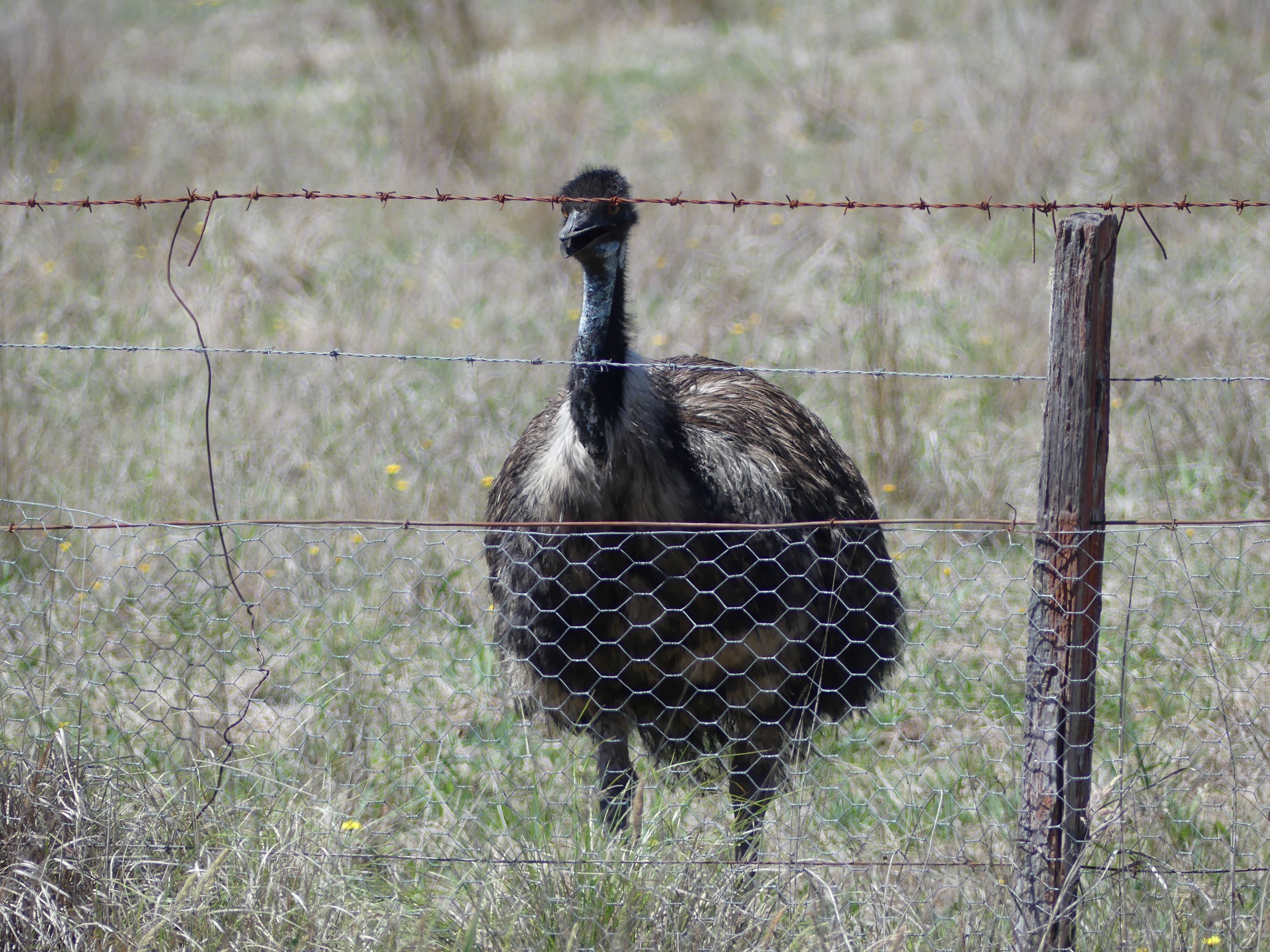
Yes, even more emus! Well, we saw two more individual emus - this one about 30km along the Grafton Rd from Glen Innes and later in the day one as we sped along the Moterway near Maclean in a young growth sugar cane field. The Glen Innes one below was very responsive to Deb's whistles from the car window, so obligingly wandered over near the fence offering us a better view. Note the light weight of the feathers fluffed up in the first photo (by a not very strong breeze).


Wednesday, August 11, 2021

Sherwood Arboretum (Aug 2019)

A further illustration of the road less travelled and what is waiting for you to explore ... as I have said many times, all we have to do from time to time is just stop for a while and look - and then see what is there! We had reason to be in Brisbane and had seen a story about the Sherwood Arboretum on the Gardening Australia show on ABC. We made time to check it out during this visit. A nice range of waterbirds were on hand as well as some magnifcent trees along the banks of the Brisbane River. Here is a sample of the birds.

First up is a pacfic black duck (with a dusky moorhen foraging just behind). I like this one up on a perch because it shows the not so obvious blue-green feather near the wing tip. This is not so obvious when they are paddling. The tinge of red is not part of the tail feathers ... it is actually the dusky moorhen beak refracted through the water under the branch! A moment in time ...

This is a hardhead, the male with the bright white eye and the light grey beak tip. There was a female around (they have a brown eye and a less contrasting grey beak tip) but I did not manage a clear shot of her. I do not have too many of these (one other I recall from a visit to Melbourne).

The next two I decided to include to show how the different light and backgrounds can provide quite different senses of the colour pallette of the same bird. This is a dusky moorhen. The bright red and yellow beak are key features (and their bobbing white tail when they are walking on land). They often seem "just black", but as you see in the first photo there are very subtle shades of blue on the breast and shoulders.Also note the fish just above right of the moorhen.


A similar "black" water bird but the beak of the Eurasian coot is a vivid white to contrast the soft black down of the head.


And from the water to the land showing its long black legs and long flexible neck is the majestic hunter that is the egret. The patient stalker hunters of the waterways.


This next one is a darter. I am used to seeing these by the river mouths around our local area, though like here, I have also captured pictures of them quite a way inland. They always look statuesque as they do such unusal things with their necks!


One of my favourites here - the Australasian grebe. Tiny little fluff-ball with a distinctive chestnut stripe on the top of the back of its neck indicating breeding plummage. The geen reflection and ripples in front the grebe really make this a beautiful scene.


Another relatively rare sighting for me was this chestnut teal. At first glance their body plummage aligns with a pacific black duck (see two photos down) but the head and red/orange eyes are the give away. Another bird that is deceptively plain until you look closely!
 

I have come to think of the white ibis as bit of a favourite. I like the way they are often captured in quite elegant (yes!) and even majestic poses - the setting (as here) needs to be right. One proudly holding its head high while the other feeds on some berries and nectar ... a trreat to see them feeding naturally ... and our fantastic clear blue sky 😗😋.


Here I offer a pair of pacific black ducks sitting in symmetry. The cream head bands and dark brown crown are distinctive. Ah ... to see nature still, yet so full of life!


I finish with another egret.  Here much closer to the water, perched on a small branch by the edge of the pond looking with its keen eyes for any movement and ever-ready to strile with that piecing sharp yellow beak. Note the fine breeding plumes at the base of the neck.


And so ends another treat from a place off the beaten track that we are so lucky to have easy access to. I hope you get to visit one day.

Friday, August 14, 2020

Winter at Lismore Lake

The second post of this trilogy presents photos from in and around Lismore Lake. Back in 2017 it had quite a deal of water in it ... at present it does not. An artificial lake that for many years was topped up with water from Wilsons River that runs parallel and as well as a wonderful public picnic space it was also a water reserve. When it was first created (I am really giving away my age here!) it was actually a water-ski lake. Unfortunately, and paradoxically, an environmental ruling meant that water from the river can no be used to keep it topped up and so during prolonged dryer spells, it dries up.

So here are some pictures for you to enjoy of the variety the full lake was attracting. You will see more in subsequent posts. One thing to keep an eye on, and that I have commented on in previous posts, is how different birds are quite comfortable sharing the same environment - of course, this is not always the case.

These three waders are both patient and efficient and have very similar strategies. The variety of plummage is a treat. 

Egrets & white necked heron


This little fella is both very pretty and colourful and fun to watch as they "duck-dive" and fly-off when their shyness alerts them to anyone close. The second one here is another perspective on the grebe with a Eurasian coot.

Australasian grebe
Australasian grebe & Eurasian coot

This next one is a lovely shot of a hardhead - the smooth mirrored surface only broken by it's wake. The striking yellow eye and white patch on the bill are key markers.

Hardhead

And here we have another pair sharing the bank as they forage for food.

Purple swamphen & magpie lark

This next sequence shows the magnificent azure kingfisher in full sunlight displaying it's dazzling colour pallette! The sequence also provides fantastic context and environment showing off just how small they are. I have my wife to thank for spotting this one as we were on the drive out. Thankfully it was not spooked when we pulled up 😀.


Azure kingfisher

Another wonderful reflection capturing the amazing variation in colour and the ease with which birds can navigate the muddiest of underfoot terrain and remain so clean!

Black-fronted dotterel

And the final two for this post offer a close-up of the distinctive plummage of the aptly named plumed whistling-duck followed by a wider angle of the flock on their island which shows what a wonderfully serene setting the lake is when full. 

Plumed whistling-duck

Plumed whistling-ducks on a full Lismore Lake


Monday, July 20, 2020

A visit to Adelaide


We are fortunate to have seven beautiful and full-on grandchildren. They are spread around the place: Norfolk in the UK, Adelaide and Casino in Australia. This visit was not long after the birth of number #3 (Felix) in Adelaide, which meant a catch up with mum & dad and Violet and Eliza too. How quickly they grow up!

So, just as the 2016 visit to Norfolk set me on this path proper, this visit to Adelaide offered a renewed awareness of birds in a very different urban environment. You will see in coming posts also, that Casino has much to offer when another set of grandchildren are visited in that more rural setting. This set of photos was captured during a visit to a very urban nature reserve: Oaklands Wetland Reserve, in the southern suburb of Warradale. You will notice a couple of "new" sightings, but also that birds from our local environment are also there 😉.

Australasian grebe

Eurasian coot

Royal spoonbill

I thought I would have a go at videoing this Royal spoonbill to capture the hoovering, or vacuuming action they use for foraging. Just 15 secs, but interesting to check out another feature of my camera deserving of more attention perhaps for demonstrating the behaviours of some of the birds?? Something for me to ponder and experiment with in time.


Purple swamphen

Pacific black duck resting

Blue Skimmer dragonfly ... come on ... it has wings!

Little pied cormorant

Yep ... also wings ... honey bees.

Pacific black duck showing off!

Australian wood duck

The ubiquitous rainbow lorikeet